
Is Night Shift Allowance Mandatory? The Legal Position
For most private-sector employers in India there is no central statute that fixes a night shift allowance or requires one to be paid. The Factories Act, the Shops and Establishments Acts and the Labour Codes regulate hours, rest intervals, spread-over, weekly offs and overtime, but they do not prescribe a premium simply for working at night. Night shift allowance is therefore a contractual or policy matter: it exists because your appointment letter, standing orders, wage agreement or HR policy says so.
There are exceptions and conditions worth knowing. Some public-sector and government pay structures include a night duty allowance. Certain state Shops and Establishments rules, and the exemptions many states granted to IT/ITeS and BPO units to operate at night, attach conditions such as transport for women employees, security arrangements and consent, rather than a cash premium. Industry wage settlements in manufacturing often include a night allowance negotiated with the union, which then becomes binding for that establishment. And once a policy is in place and paid consistently, it becomes a term of employment that cannot be withdrawn unilaterally.
So the correct framing is: you must comply with hour limits, rest, overtime and, for women, the OSH Code's night-work safeguards; you may choose to pay a night allowance; and if you do, write the rule down so payroll can apply it mechanically. The night shift allowance glossary entry gives the one-paragraph definition.
- No central statutory night shift allowance for private-sector employees generally
- Some state rules and IT/ITeS night-work exemptions impose conditions (transport, safety, consent), not cash premiums
- Union settlements and public-sector pay rules may include a night allowance that binds that establishment
- Once paid consistently under policy, the allowance becomes a term of employment
Defining 'Night' So Payroll Can Apply It
The word night has no fixed payroll meaning until you define it. The Factories Act uses a 22:00 to 06:00 window for certain provisions, and many policies borrow that band. A workable definition is: a night shift is any shift in which at least 4 scheduled hours fall between 22:00 and 06:00. Under that rule a 20:00 to 08:00 security post qualifies (8 night hours), a 14:00 to 23:00 second shift does not (1 night hour), and a 22:00 to 06:00 factory C-shift qualifies fully.
Decide whether the allowance attaches to the shift or to the hours. Shift-based: any qualifying shift earns one unit of allowance regardless of exact night hours. Hours-based: each hour between 22:00 and 06:00 earns a premium. Shift-based is simpler and is what most guards, hospital staff and BPO teams expect; hours-based is fairer for staggered rosters. Whichever you choose, the attendance system must be able to identify the shift the person was rostered on and actually worked, not just the punches, because a 12-hour night post from 20:00 to 08:00 crosses midnight and belongs to the day it started.
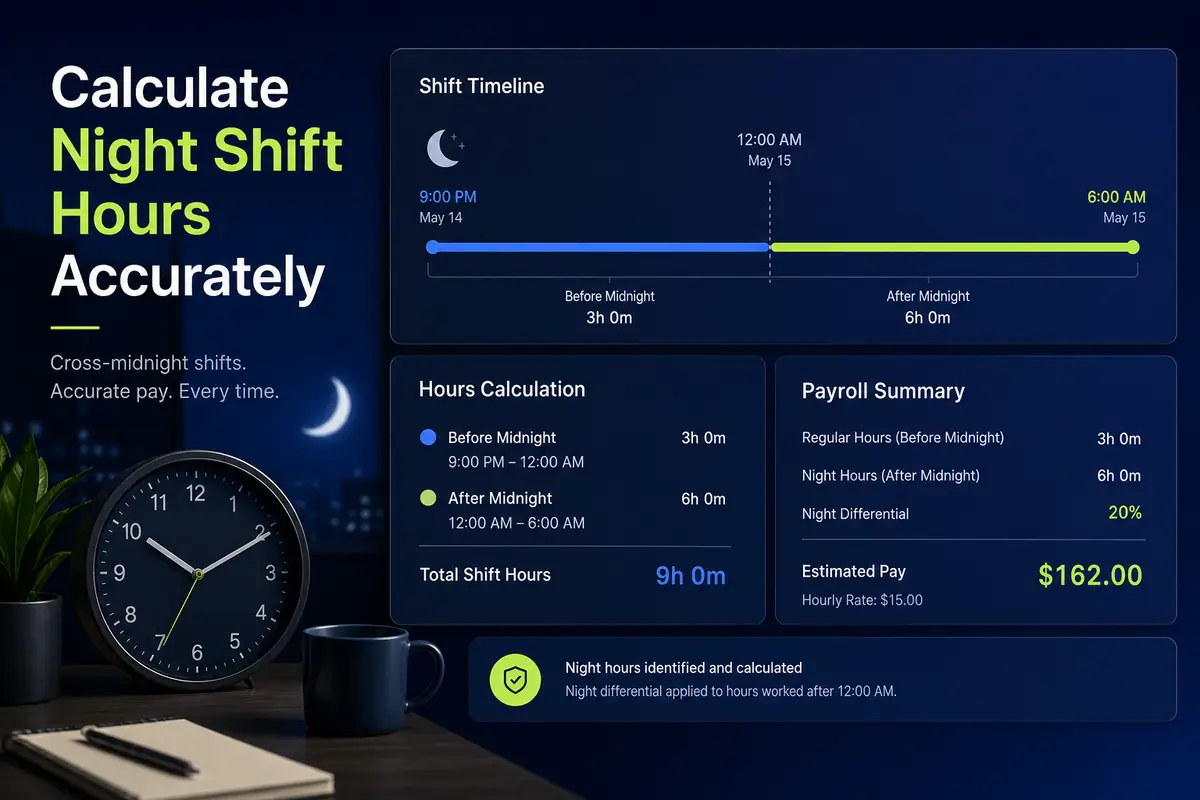
Handle the edge cases in the definition itself: a person who leaves early at 02:00 from a 20:00–08:00 post (allowance pro-rated or forfeited?), a day-shift employee called in at 23:00 for a breakdown (paid as overtime, and does the night allowance also apply?), and a half-day on a night shift. Write the answer for each, because payroll will otherwise decide case by case. The night shift hours for payroll guide covers the midnight-crossing arithmetic.
- Define a night shift precisely, e.g. at least 4 scheduled hours between 22:00 and 06:00
- Choose shift-based (per qualifying shift) or hours-based (per night hour) attachment
- Attribute shifts crossing midnight to the start date for attendance and payroll
- Write rules for early exits, call-ins and half-days on night shifts
Three Common Designs: Flat, Percentage and Hourly Premium
Flat per night is the most common design in security, facility management, hospitals and manufacturing: a fixed rupee amount for every qualifying night shift worked, for example ₹150 per night. It is simple to explain, simple to audit (nights worked × rate) and cost-predictable. Its drawback is that it does not scale with salary, so a supervisor and a guard earn the same premium, which may or may not be your intent.
Percentage of basic per night is common in white-collar 24/7 operations such as BPOs and IT support: for example, 10% of daily basic for each night shift, or a monthly night allowance of a percentage of basic for anyone permanently on nights. It scales with seniority and keeps the allowance in proportion as salaries rise. Hourly premium is the third design: an uplift per night hour, say 20% of the hourly rate for each hour between 22:00 and 06:00. It is the most precise for rotating or staggered rosters and the most demanding of the attendance system.
Whichever design you use, keep the allowance as a separate earning line named 'Night Shift Allowance' on the payslip, with the number of nights or night hours shown. Folding it into a lump-sum 'other allowance' loses the audit trail and makes it impossible to prove the premium was paid when a worker disputes it.
- Flat per night: simple, predictable; same premium for all grades
- Percentage of basic per night or per month: scales with salary; common in BPO/IT
- Hourly premium on night hours: most precise; needs hour-level attendance
- Always show it as a separate payslip line with nights or night hours counted
Night Allowance Is Not Overtime: Keeping the Two Apart
Night shift allowance compensates for working unsocial hours within normal working time. Overtime compensates for working beyond normal working time, at not less than twice the ordinary rate under the Factories Act and the Code on Wages. They are different triggers and can both apply to the same shift, but one is never a substitute for the other. Paying a generous night allowance does not excuse paying single rate for the four extra hours of a 12-hour post against an 8-hour day.
Work the 12-hour night post through: a guard on ₹18,000 monthly wages, 20:00 to 08:00, in a state where the notified day is 8 hours. Ordinary hourly rate = 18,000 ÷ 26 ÷ 8 = ₹86.54. The post contains 8 normal hours (already in the monthly wage) and 4 overtime hours at ₹173.08 each = ₹692.31. If policy pays ₹150 per night, the guard also earns ₹150 night allowance. Both lines appear separately. The overtime calculation formula under Indian labour law covers whether the allowance forms part of the 'ordinary rate' for OT purposes; the common position is that a purely contractual allowance is excluded, but check the definition in your state rules and your wage settlement.
One design question is whether the allowance itself is doubled during overtime night hours. Most policies say no: the allowance is per shift or per night hour at a single rate; overtime is separately doubled on the wage rate. State that explicitly.
- Night allowance = premium for unsocial hours within normal time; overtime = premium for extra hours at 2x
- A 12-hour night post against an 8-hour day earns both: 4 OT hours at double rate plus the night allowance
- Do not offset one against the other or fold the allowance into the OT rate without checking the wage definition
- State whether the allowance is doubled during OT hours (usually not)
Taxability and Statutory Treatment of Night Shift Allowance
Night shift allowance is fully taxable as salary in the employee's hands. There is no specific exemption under section 10 of the Income Tax Act for it, so it is added to gross salary for TDS under either regime. Employers sometimes assume it is a reimbursement or a 'special allowance' with exempt treatment; it is neither. Show it in the taxable components when projecting annual income for TDS.
For EPF, the allowance is generally an excluded allowance rather than basic or DA, but under the Labour Codes' 50% rule it is one of the components that gets added back to wages if total excluded allowances exceed half of remuneration. For ESIC, which is tested on gross wages, the allowance counts toward the ₹21,000 ceiling and toward the contribution base for employees under it; a regular night allowance can push someone over the ceiling, though they continue contributing until the end of the current April–September or October–March period. For the Payment of Bonus Act and gratuity, which use basic plus DA, a separately named night allowance is generally excluded.
- Fully taxable as salary; no section 10 exemption
- Generally outside EPF wages unless the 50% add-back under the Codes pulls it in
- Counts toward ESIC gross wages and the ₹21,000 ceiling test
- Generally excluded from bonus and gratuity bases, which use basic plus DA
Attendance Rules That Trigger the Allowance Automatically
The allowance should be earned by data, not by a supervisor's monthly list. That needs four things in the attendance system: a shift template flagged as a night shift (or with hours that the system can test against the 22:00–06:00 band), a roster that assigns the shift to the person, a check-in and check-out that confirm the shift was actually worked within the tolerance you set, and a rule that produces a count of qualifying nights or night hours per employee per month.
Then define the tolerance. A guard who checks in at 20:10 against a 20:00 post and leaves at 08:00 has worked the night shift and earns the allowance; a guard who leaves at 01:00 has not, unless your policy pro-rates. A person who swapped from a day shift into a night shift with approval earns it; the person they swapped with does not. If the shift template, roster and punches are in one system, all of this is a calculation rather than a monthly argument.
In Attend Mitra, night shift templates and shifts crossing midnight are set up once, the weekly roster assigns them, and attendance is recorded by GPS, face or kiosk with the shift the person was rostered on. The payroll run can then count worked night shifts per employee and carry them into an allowance line with the count visible on the payslip. For roster patterns that keep night coverage fair, see 12-hour shift schedules for 24/7 coverage and the night shift glossary entry.
- Flag night shift templates; roster them; verify with check-in/out; count qualifying nights per month
- Set tolerance rules for late arrival and early exit on a night shift
- Approved shift swaps move the allowance to the person who actually worked
- Carry the night count into a separate payslip line rather than a manual list
Worked Example and Sample Policy Clauses
Example: a hospital ward attendant on basic ₹14,000 and gross ₹19,500 works 10 night shifts (20:00–08:00) and 12 day shifts in a month, on a policy of ₹150 per night. Night shift allowance = 10 × ₹150 = ₹1,500. Gross for the month becomes ₹21,000 before overtime. ESI is tested on ₹21,000 (still within the ceiling), so employee ESI is 0.75% × 21,000 = ₹158. PF employee share is 12% of basic ₹14,000 = ₹1,680 (the allowance is excluded and total excluded allowances are 33% of remuneration, so no add-back). The allowance is fully taxable, though at this income level TDS under the new regime is nil. Each 12-hour night shift also carries overtime hours if the notified day is 8 hours; those are computed and shown separately.
Sample clauses you can adapt. Definition: 'A night shift is any rostered shift in which at least four scheduled hours fall between 22:00 and 06:00.' Entitlement: 'An employee who is rostered on and completes a night shift, as verified by attendance records, is paid a night shift allowance of ₹[amount] per night shift, shown separately on the payslip.' Early exit: 'No allowance is payable if the employee leaves more than two hours before the scheduled end without approval.' Overtime: 'The allowance is in addition to, and not in substitution for, overtime wages payable under applicable law.' Taxation: 'The allowance is taxable as salary.' Review: 'The allowance rate is reviewed annually and may be revised with 30 days' notice.'
- Example: 10 nights × ₹150 = ₹1,500 night allowance, shown separately, fully taxable, inside ESI gross
- Clauses: definition, entitlement verified by attendance, early-exit rule, OT independence, taxability, review
- Publish the policy, obtain acknowledgement and apply it identically across sites
Women on Night Shifts: Consent, Transport and Safety
The OSH Code allows women to work at night in any establishment, subject to their consent and to the conditions the appropriate government prescribes for safety, holidays and working hours. State rules, and the earlier state exemptions for IT/ITeS, hospitals and hospitality, typically specify: written consent that can be withdrawn; transport from residence to workplace and back, with a security guard where the state requires; adequate lighting and CCTV at the workplace and its approaches; a minimum number of women on the shift in some states; a functioning internal complaints committee; and restroom and rest facilities.
Build these into the roster process rather than treating them as a one-time HR form. Consent is recorded before the first night roster and re-confirmed periodically. The roster builder should warn when a woman is scheduled alone at night at a site or when the transport arrangement is not marked. A night allowance does not substitute for these safeguards; both are needed, and only the safeguards are legally required.
- Night work by women is permitted under the OSH Code with consent and prescribed safeguards
- Typical conditions: revocable written consent, transport, lighting and CCTV, minimum group size, complaints committee
- Record consent and safeguards against the roster, not in a separate file
- The allowance is optional; the safeguards are mandatory