
Start From Call Volume by Interval, Not From Shift Names
A call center schedule is a staffing curve, not a list of shift timings. Pull the last 8 to 12 weeks of contact volume from the dialler or ACD in 30-minute intervals, by day of week, and note the average handling time for each queue. Multiply volume by handling time to get workload minutes per interval, then convert it to agents required at the service level you have promised the client (for example 80 percent of calls answered in 20 seconds). Add a shrinkage factor for breaks, training, coaching and unplanned absence; Indian domestic processes commonly plan for a third or more of paid time being unavailable for calls, but measure your own.
The curve tells you where the peaks are. A domestic customer-service line typically peaks between 10:00 and 13:00 and again from 17:00 to 20:00 on weekdays, with a lower Sunday profile; an international voice process for a US client peaks in Indian night hours. Your schedule's job is to put agents where the curve is high and not pay them where it is low. Shift timings follow from that, which is why two call centers in the same building can have completely different rosters.
Keep the forecast honest by comparing it with actual volume every week. A schedule built on a stale forecast produces the two classic BPO failures at once: abandoned calls at 11:00 and idle agents at 15:00. Re-forecast monthly, and re-forecast immediately when a client adds a campaign, changes IVR flow or launches a product.
- Forecast volume × handling time per 30-minute interval, by weekday
- Convert workload to agents required at the promised service level
- Apply a measured shrinkage factor, not a guessed one
- Compare forecast to actual weekly and re-plan monthly
Shift Shapes That Fit the Curve
The workhorse shape is a 9-hour shift with a 1-hour unpaid break split into two 15-minute tea breaks and a 30-minute meal, giving 8 hours of paid, loggable time. Stagger login times in 30-minute or 1-hour steps (08:00, 08:30, 09:00, 09:30 and so on) so that headcount rises with the morning curve rather than arriving all at once. Because 9 hours a day and 48 hours a week is the ceiling under most state Shops and Establishments Acts, a 9-hour shift with a 1-hour break is comfortably inside the limit; see working hours as per labour law for the spread-over and rest rules that apply.
Split shifts (for example 09:00–13:00 and 17:00–21:00) match a two-peak curve with fewer agents, and they are legal within the state's spread-over limit, but they are unpopular and lead to attrition unless the gap is short or the agent lives close by. Use them sparingly, pay a split-shift allowance if you rely on them, and give agents the choice. The split shift glossary entry explains the spread-over arithmetic.
Night shifts are unavoidable for international processes: a US East Coast window means roughly 18:30 to 03:30 IST, UK and Europe run around 13:30 to 22:30 IST, and Australia sits in the Indian early morning. Plan night shifts as fixed crews for a fortnight or a month rather than rotating agents through days and nights weekly, because frequent direction changes are what damages sleep and quality scores. Night work also attracts a night-shift allowance in most BPO pay structures; the policy options are in night shift allowance policy.
- 9-hour shift, 1 hour of breaks, staggered logins in 30-minute steps
- Split shifts only for sharp two-peak curves, with allowance and consent
- International windows: US 18:30–03:30, UK/EU 13:30–22:30 IST (approximate)
- Fixed night crews for a fortnight or a month, not weekly flips
Rotation Patterns and Week-Offs in a 7-Day Operation
Most call centers run six or seven days a week, so week-offs rotate. The clean pattern is 5 working days and 2 consecutive offs, with the pair of off days rotating through the week so that everyone gets a Saturday–Sunday pair every few weeks. A 6-day process uses 1 off per week rotating similarly, and must still give every agent one whole day of rest in each week under the Factories Act and state Shops and Establishments Acts; the rules and comp-off treatment are in weekly off rules as per labour law.
Staffing maths for a 7-day process: if the curve needs 60 agents logged in every day, and each agent works 5 of 7 days, you need 60 × 7 ÷ 5 = 84 agents on the roster before shrinkage, and more after. If 30 percent of paid time is shrinkage, gross that up to about 120. Run this calculation per shift band (morning, day, evening, night) rather than for the whole floor, because shrinkage and week-off preferences differ by band.
Publish the roster at least a week ahead, and a fortnight ahead for night processes where transport and family arrangements depend on it. Ready-made rotation cycles for day-and-night crews are described in rotating shift schedule examples, and a grid you can adapt to staggered logins is available as the shift schedule template in Excel.
- 5-on-2-off with rotating consecutive off days is the default for 7-day processes
- Every agent gets one whole rest day in every week, without exception
- Roster headcount = daily requirement × 7 ÷ working days, then gross up for shrinkage
- Publish a week ahead; a fortnight ahead for night processes
Shift Bidding and Swaps Without Favouritism
Once the schedule has a fixed set of shift slots, the question is who gets which. Shift bidding lets agents rank the available slots, and the planner allocates by a transparent priority order, typically tenure, then quality score, then attendance record over the last quarter. Publish the criteria before the bid opens, run it monthly or quarterly, and show each agent where they placed. Agents accept a 07:00 login far more readily when they can see they were outbid on a rule rather than overlooked by a team leader.
Rotate the unpopular slots deliberately. If the 04:00 logout and the Sunday shift always fall on the same low-tenure agents, attrition in that group rises within a quarter. Cap the number of consecutive weeks anyone holds a least-preferred slot, and let the bid engine enforce the cap.
Swaps are the safety valve. Allow agent-to-agent swaps within the same skill and shift band, subject to team-leader approval, with the rule that the swap must not push either agent beyond daily or weekly hour limits or remove their weekly off. A swap agreed on WhatsApp and not reflected in the roster is what produces the ‘present but marked absent’ dispute at month end; the shift swap entry sets out the approval rules that prevent it. An app-based swap request, approved by the team leader and written straight into the published roster, closes that gap.
- Bid allocation by published criteria: tenure, quality, attendance
- Cap consecutive weeks on least-preferred slots
- Swaps only within skill and band, with approval and hour-limit checks
- Every swap must update the roster the attendance system reads
Night Shift Compliance, Transport and Women Agents
Night work for women employees is regulated under state Shops and Establishments Acts and the IT/ITeS exemptions most states have notified, and the conditions are broadly similar: written consent from the employee, safe transport from and to the residence with a security escort where the trip starts or ends after a set hour, adequate lighting and security at the premises, a functioning internal committee under the sexual-harassment law, and in several states a minimum number of women on each night shift. The exact conditions and the hours that count as night differ by state, so obtain the current notification for each city you operate in and build it into the roster rules rather than into a memo.
Transport is a scheduling input, not an afterthought. Cab routes are planned by pickup and drop clusters, so a roster that lets logins spread across every 15-minute interval multiplies vehicles. Batch night logins into two or three waves that align with cab capacity, and lock the roster far enough ahead for the transport vendor to plan. Keep the pickup and drop logs; they are the record that the safe-transport condition was met.
The Labour Codes keep the 48-hour week and require consent for overtime, so an agent asked to extend through a volume spike past the scheduled logout must have agreed and must be paid overtime at not less than twice the normal rate for the extra time. Record extension approvals in the system, not verbally, and cap them so that no agent breaches daily limits or loses the rest gap before the next login.
- Women on night shift: consent, safe transport with escort, security, committee, state-specific conditions
- Batch night logins into waves aligned with cab capacity
- Overtime extensions need consent, double-rate pay and a logged approval
- Keep transport logs as compliance evidence
Attendance Rules: Login Time, Adherence and Leave Planning
Call centers pay for logged-in time, so attendance has to be defined around the dialler login, not the security gate. Set the rule explicitly: the shift start is the scheduled login, the grace period is a fixed number of minutes after it, a late mark applies beyond grace, and a half-day applies beyond a further threshold. Early logout follows the mirror rule. Gate entry from a biometric or face terminal remains useful as the presence record, but the attendance status that drives LOP and incentives should read from the assigned shift and the login-based punch.
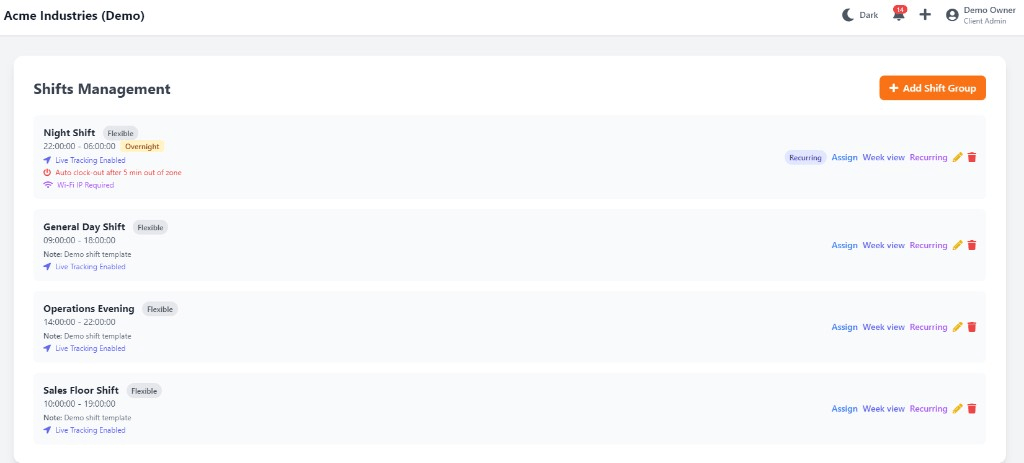
Schedule adherence, the share of scheduled minutes an agent was actually in the planned state, is the day-to-day operational metric, and it needs the roster and the attendance record in the same place. If the roster says 09:30 login with breaks at 11:30 and 15:00, and the agent logged in at 09:42, took a 40-minute meal and left 20 minutes early, the adherence figure tells the team leader what to coach and the payroll team what to deduct. Attend Mitra's shift templates with grace, late-mark and early-exit rules, its roster builder with draft-then-publish and approval-based swaps, and its live monitor showing who is present, late or absent on each shift are built for this pattern; the BPO and call center shift management page describes the setup.
Leave planning closes the loop. Because shrinkage is already in the forecast, planned leave has a budget per shift band per day; approve within it, and let the system warn when someone with approved leave is still rostered. Publish blackout periods for known peaks (a client's billing-cycle week, festival sales) months ahead. For hourly and part-time agents used to flex the peaks, the rules in how to schedule hourly employees apply directly.
- Define shift start as scheduled login, with explicit grace, late-mark and half-day thresholds
- Track schedule adherence from roster and attendance together
- Cap planned leave per shift band per day inside the shrinkage budget
- Warn when an agent on approved leave remains rostered