
Why Mumbai payroll slips every month
Maharashtra PT applied from memory
The ₹175 and ₹200 slabs, the ₹300 February month and the ₹25,000 exemption for women sit as hard-coded Excel formulas that quietly go stale.
Multi-site attendance arrives late
Guards in Andheri, housekeeping at BKC and back-office staff in Thane report through WhatsApp; the salary sheet waits for supervisors to reconcile.
LOP and overtime disputed after payout
Without a timestamped record, a 20:00 to 08:00 night post becomes an argument about whether it was eight hours or twelve.
Registers not ready for inspection
The Maharashtra S&E Act 2017 expects attendance, wage and leave records per establishment; assembling them from screenshots takes days.
How Attend Mitra handles the Maharashtra layer
PT slab engine by work location
Set Maharashtra PT once; the monthly deduction follows each employee's gross, the women's exemption and the February rate automatically.
Attendance cut-off feeds the salary register
Freeze attendance on your cut-off date; present days, LOP and approved overtime flow into the register without retyping.
PF and ESI at the current ceilings
EPF on the ₹25,000 ceiling effective 17 September 2026 with the September split handled, ESI at ₹21,000 gross with period lock-in.
Inspection-ready registers
Attendance register, wage register and leave records export per establishment for the labour inspector, the principal employer or your CA.
Payroll features built for Mumbai employers
Maharashtra PT slabs
Nil up to ₹7,500; ₹175 for ₹7,501–10,000; ₹200 above ₹10,000 with ₹300 in February; women exempt up to ₹25,000.
EPF and EPS split
Employee 12% of basic plus DA; employer 8.33% to EPS on ceiling wages and 3.67% to EPF, with EDLI and admin charges shown separately.
ESI on gross wages
Employee 0.75% and employer 3.25% on gross up to ₹21,000; an employee who crosses mid-period keeps contributing until the period ends.
LOP from verified attendance
Face, GPS or kiosk punches decide paid days; missing punches become LOP unless a regularisation request is approved.
Payslips in the employee app
Employees download payslip PDFs from self-service; HR exports a single ZIP for the month or one PDF per person.
NEFT file and accounting export
Bank-transfer file for salary credit plus CSV and XLSX exports of the salary register for Tally, your CA or another payroll system.
Excel salary sheet vs generic payroll tool vs Attend Mitra for Mumbai payroll
What changes when the Maharashtra layer is built in rather than bolted on.
| Criterion | Excel salary sheet | Generic payroll tool | Attend Mitra |
|---|---|---|---|
| Maharashtra PT (₹175/₹200, ₹300 in February, women exempt to ₹25,000) | Formula maintained by hand; February often missed | Usually supported; check the women's exemption | Configured per establishment; February rate and exemption applied automatically |
| Attendance to LOP and overtime | Copied from registers or WhatsApp | Imported from a separate attendance file | Read from frozen, verified attendance in the same system |
| EPF ₹25,000 ceiling from 17 Sep 2026 (September split) | Every row reworked manually | Depends on vendor update | Ceiling and split period built into the run |
| Maharashtra LWF half-yearly deduction | Remembered twice a year, if at all | Varies by product | Configurable deduction line per establishment |
| Registers under Maharashtra S&E Act 2017 | Assembled from multiple sheets | Generic register formats | Attendance, wage and leave registers exported per establishment |
| Payslips and bank file | PDFs made one by one | Payslips yes; bank file varies | Payslip PDFs (single or ZIP), NEFT file, self-service app |
| Multi-site guards and housekeeping | Supervisor tallies per site | Not attendance-aware | GPS and selfie punches per site with man-hour exports for billing |
From Check-In to Payroll-Ready Reports
Set up the state layer once
Create each establishment with its state, professional tax schedule, PF and ESI settings, LWF line and a wage master loaded from the latest minimum-wage notification.
Capture attendance every day
Face, GPS, kiosk or web punches run against shift rules, so late marks, early exits, overtime and approved leave are recorded as they happen rather than reconstructed at month-end.
Freeze attendance on the cut-off date
Lock the month; pending regularisation requests are approved or rejected with an audit trail before anything reaches the salary register.
Run payroll and review exceptions
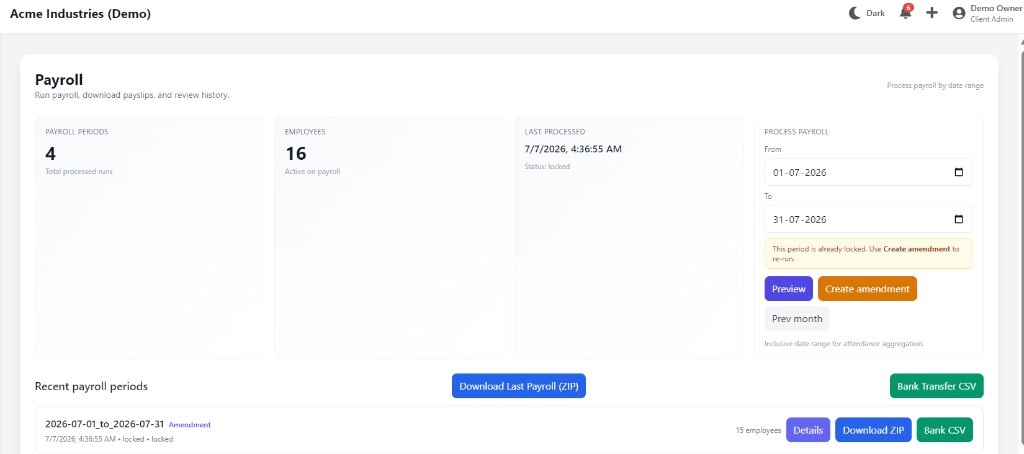
LOP, overtime, PF, ESI and PT are computed from the frozen record. Review joiners, exits, ceiling crossings and arrears before approving the run.
Pay, publish and hand over
Generate the NEFT bank file, payslip PDFs and salary register; export PF, ESI and PT summaries for your consultant to file the statutory returns.
What changes for HR and finance
One PT table for every Mumbai location
Andheri, BKC, Navi Mumbai and Thane employees all fall under Maharashtra PT, so deductions stay consistent across branches and client sites.
Payroll closes on time
Because attendance freezes on the cut-off date, the salary register is ready for review instead of being rebuilt from supervisor messages.
Fewer overtime disputes
Double-rate overtime beyond the daily limit is computed from timestamped punches, using the 26-day divisor and 8-hour day for daily-rated staff.
Contract labour exposure reduced
Principal employers can see contractor attendance and wage registers, which matters because liability for unpaid PF or ESI stays with them.
Clean handover to your consultant
Salary register, PF, ESI and PT summaries export in one pass, so ECR, ESIC and Maharashtra PT returns are prepared from one dataset.
Employees self-serve
Payslips, leave balances and attendance history live in the app, which cuts the month-start queue at the HR desk.
Mumbai payroll scenarios
Security agency with 40 client sites
Guards on 12-hour rotations across the western suburbs, paid on the 26-day divisor and billed to clients by verified man-hours.
e.g. a guard posted 20:00–08:00 for 26 nights has GPS and selfie-verified hours per site, so agency payroll and the client invoice draw from the same record.
BFSI back-office in Lower Parel
Monthly-salaried shift teams on web and kiosk attendance, most above the ESI ceiling and all in the ₹200 PT slab.
e.g. an analyst on ₹45,000 gross sees ₹200 PT (₹300 in February) and PF on ₹25,000 ceiling wages on the payslip without a manual override.
Facility-management contractor
Housekeeping and technicians across malls and IT parks, with separate contract-labour registers for each principal employer.
e.g. a housekeeping supervisor's four LOP days flow from missing punches into the wage register, with the regularisation trail available if the principal employer asks.
Frequently Asked Questions
Ready to Simplify Payroll Software Mumbai Attendance?
Book a free demo and see how Attend Mitra helps Indian businesses track attendance, manage shifts, and export payroll-ready reports.
