
The Legal Floor: What a Private Company Must Give, and Where It Is Written
There is no single national leave law for private companies in India. The minimum leave you owe depends on which statute covers your establishment. A factory registered under the Factories Act 1948 follows Chapter VIII of that Act. An office, shop, warehouse, hotel or software company follows the Shops and Establishments Act of the state where the premises sit. A security agency or facility-management company usually falls under the Shops and Establishments Act at head office and, for guards deployed inside a client's factory, may also have to honour the leave that the principal employer's factory rules provide.
The Factories Act sets a clear formula: an adult worker who has worked at least 240 days in a calendar year earns one day of leave with wages for every 20 days worked in that year, and unused leave carries forward up to 30 days. The state Shops and Establishments Acts are more varied. Most prescribe earned or privilege leave in the range of 12 to 18 days a year, casual leave of up to 12 days and sick leave of up to 12 days, but the exact figures, the qualifying period and the carry-forward cap differ by state. Check your state's Shops and Establishments Act and its rules before writing any number into your policy.
Two further statutes sit above whatever your state Act says. The Maternity Benefit Act (as amended in 2017) gives 26 weeks of paid maternity leave for the first two children and 12 weeks thereafter to women in establishments with 10 or more employees, subject to 80 days of work in the 12 months before the expected delivery. And each state's National and Festival Holidays Act prescribes a set of paid holidays, typically the three national holidays plus a state-specific list of festival holidays that the employer picks from a notified schedule. The count and the list vary by state, so a company with offices in Gurugram and Bengaluru will have two different holiday calendars.
The four Labour Codes came into force on 21 November 2025. The Occupational Safety, Health and Working Conditions Code 2020 carries the one-day-per-20-days earned leave formula across from the Factories Act, but final central and state rules are still being notified, and the older Acts continue to operate for matters not yet covered. In practice this means your leave policy must satisfy the more generous of the old Act and the new Code for now. A fuller compliance map is in our guide to India leave compliance.
- Identify the governing statute for each location: Factories Act, or the state Shops and Establishments Act
- Treat the statutory figures as a floor; your policy can give more, never less
- Maintain a separate holiday calendar per state, because festival holiday lists differ
- Re-check state rules under the Labour Codes each year until the transition settles
Leave Types Every Private Company Should Define
A leave policy fails when it leaves categories undefined and lets managers improvise. Every request then becomes a negotiation, and payroll inherits the argument at month-end. Define each leave type with a purpose, an annual quantum, an accrual method, an application notice period, a carry-forward rule and an encashment rule. The main types used by Indian private companies are listed below; you do not need all of them, but each one you use must be written down.
Earned leave (also called privilege leave or annual leave) is the leave a person earns by working; it is the only type most statutes require you to carry forward and pay out on exit. Casual leave covers short, unplanned personal needs and normally lapses at year-end. Sick leave covers illness, often with a medical certificate required beyond two or three consecutive days. Compensatory off is granted for work on a weekly off or holiday. Leave without pay (LWP or LOP) is what applies when balances are exhausted or leave is unapproved.
Maternity leave is statutory and must follow the Act, not your policy. Paternity leave is not statutory for private-sector employees in India; if you offer it, state the number of days and the window in which it must be taken. Bereavement leave, marriage leave and study leave are optional and usually short. Whatever you include, keep the total number of leave types small enough that a supervisor on a construction site can explain them from memory.
- Earned or privilege leave: accrues with service, carries forward, encashable on exit
- Casual leave: short-notice personal leave, lapses at year-end, usually not more than 2–3 days at a stretch
- Sick leave: illness-related, medical certificate beyond a stated number of days, may carry forward or lapse
- Compensatory off: earned by working on a weekly off or holiday, with an expiry window
- Maternity leave (statutory), plus optional paternity, bereavement and marriage leave
- Leave without pay: the default when balances are exhausted or leave is unapproved
Accrual, Carry-Forward and Encashment Rules
Accrual is the schedule on which leave is credited. The two common models are annual credit (the full year's entitlement credited on 1 January or on the anniversary of joining) and monthly accrual (for example 1.5 days of earned leave credited at the end of each month for an 18-day annual entitlement). Monthly accrual protects you when someone resigns in March after taking 18 days of leave in February; annual credit is simpler to administer but creates a negative-balance recovery problem on exit. Most companies with high attrition or many contract workers use monthly accrual for earned leave and annual credit for casual and sick leave.
Carry-forward is the amount of unused earned leave that moves into the next year. Statute sets a minimum (30 days under the Factories Act; check your state Act for shops and establishments) and your policy may set a higher cap. Above the cap, leave either lapses or is encashed. Casual leave almost always lapses; sick leave is a policy choice. Write the lapse date explicitly (31 December or 31 March, depending on your leave year) so nobody argues about it in January.
Encashment is payment for unused earned leave, either on exit (required by most statutes for earned leave) or annually above the carry-forward cap (a policy choice). State the basis clearly: most companies pay on basic plus DA, some on gross. State the per-day divisor too, because ₹26,000 basic divided by 26 gives ₹1,000 a day while divided by 30 gives ₹866.67, and the difference on a 30-day balance is ₹4,000. The full rules and tax treatment are covered in our guide to earned leave rules and calculation.
- Choose monthly accrual for earned leave where attrition is high; annual credit where it is low
- Write the carry-forward cap and the lapse date into the policy, not just into the software
- State the encashment wage basis (basic plus DA or gross) and the per-day divisor (26 or 30)
- Decide whether negative balances on exit are recovered from the final settlement, and say so
Probation, Notice Period, Sandwich Rule and the Approval Workflow
Probation is where most leave disputes begin. Common private-sector practice is that earned leave accrues during probation but cannot be availed until confirmation, while casual and sick leave are available pro-rata from the date of joining. Statutory earned leave under the Factories Act is not conditional on confirmation, only on days worked, so a factory cannot lawfully refuse earned leave to a probationer who has met the qualifying days. Write the probation rule so that it satisfies the statute for statutory leave and is clearly labelled as a company rule for the rest.
Notice period is the second flashpoint. Many companies bar earned leave during the notice period so that the handover actually happens, and treat any leave taken during notice as either extending the notice period or being deducted as LOP. This is lawful if it is in the policy and the appointment letter, but the unused earned leave balance must still be encashed in the final settlement. Casual and sick leave during notice are usually permitted only with a certificate.
The sandwich rule (counting a weekly off or holiday that falls between two leave days as leave) is a policy choice, not a legal requirement. If you adopt it, define exactly when it applies, exclude sick leave with a medical certificate, and make sure your leave software applies it identically to everyone. Our detailed guide to the sandwich leave rule walks through the variants and the payroll impact. For the approval workflow, define who approves (the reporting manager, with HR as second approver above a stated number of days), the notice period for planned leave (commonly 7 days for 1–2 days of earned leave and 15–30 days for longer spells), and what happens when a manager does not respond within a set time (auto-escalate, not auto-approve).
- Statutory earned leave cannot be denied to probationers who have met the qualifying days
- Bar earned leave during notice only if the policy says so, and still encash the balance on exit
- Adopt the sandwich rule only in writing and apply it through the software, not manager discretion
- Set an escalation path for unactioned leave requests, never a silent auto-approval
Connecting Leave to Attendance and Payroll
A leave policy that lives in a PDF and a leave register that lives in Excel will drift apart within a quarter. The linkage that matters is between the approved leave record, the attendance record and the payroll run. On any day, an employee is either present, on approved paid leave, on approved unpaid leave, on a holiday or weekly off, or absent without approval. Payroll needs exactly that classification for every calendar day, and it needs it by the 1st of the month.
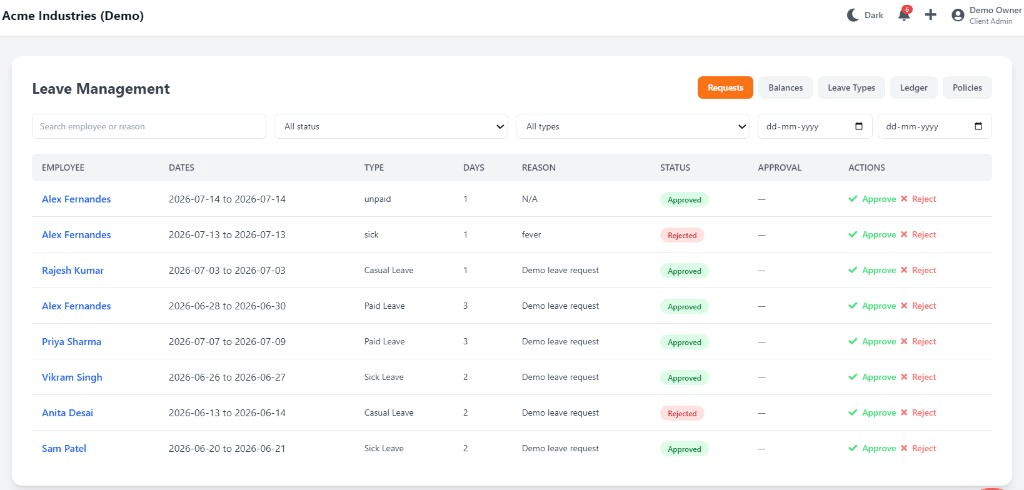
This is why leave and attendance should sit in the same system. When a leave request is approved in the app, the roster should already show that person as unavailable, so a supervisor is warned before assigning them to a shift. When the leave balance runs out, the remaining days should flow into payroll as loss of pay automatically, using the same per-day divisor your policy states. Attend Mitra handles this chain end to end: leave policies with accrual for paid, casual and sick leave, approval in the app with balances visible to the employee, a holiday calendar per branch, a roster warning when someone with approved leave is scheduled, and LOP flowing into the attendance-linked payroll run.
Whatever system you use, the policy document should name it, state that the app record is the official leave record, and describe how corrections are made. Our guide to setting up leave policies covers the configuration steps in detail.
- Classify every calendar day for every employee: present, paid leave, unpaid leave, holiday or weekly off, unauthorised absence
- Warn rostering supervisors automatically when approved leave clashes with a shift
- Let exhausted balances become LOP in payroll without manual re-entry
- Name the system of record in the policy and define the correction process
Sample Leave Policy for a Private Company (Adapt the Numbers to Your State)
The clauses below form a complete leave policy for a private company with monthly-paid staff. The numbers are illustrative and sit within the typical ranges of most state Shops and Establishments Acts; replace them with your state's figures where the statute is higher. Read each clause aloud to a line supervisor before you adopt it. If the supervisor cannot explain it, simplify it.
- 1. Purpose and scope. This policy sets out the leave entitlements and procedures for all employees of the Company across all locations. Where a statute applicable to a location provides a higher entitlement, the statute prevails for employees at that location.
- 2. Leave year. The leave year runs from 1 January to 31 December. Leave balances are maintained in the Company's attendance and leave system, which is the official record.
- 3. Earned leave (EL). Employees earn 1.5 days of EL for each completed month of service, credited on the last day of the month, giving 18 days a year. EL accrues during probation and may be availed after confirmation, except where the applicable statute permits earlier use. EL may be carried forward to a maximum balance of 45 days; the excess is encashed at year-end on basic plus DA, divided by 30.
- 4. Casual leave (CL). Employees are entitled to 8 days of CL per leave year, credited pro-rata on joining. CL may not be taken for more than 3 consecutive days and may not be combined with EL. Unused CL lapses on 31 December.
- 5. Sick leave (SL). Employees are entitled to 8 days of SL per leave year, credited pro-rata on joining. SL beyond 2 consecutive days requires a medical certificate from a registered practitioner. Unused SL may be carried forward up to a maximum balance of 24 days and is not encashable.
- 6. Maternity leave. Women employees are entitled to maternity leave and benefits in accordance with the Maternity Benefit Act 1961 as amended, including 26 weeks of paid leave for the first two children. Where the employee is covered under the ESI Act, maternity benefit is claimed from ESIC and the Company will provide the necessary certificates.
- 7. Paternity leave. Male employees are entitled to 5 working days of paid paternity leave, to be taken within 30 days of the birth or adoption of a child, for up to two children. This is a Company benefit and not a statutory entitlement.
- 8. Compensatory off. An employee who works a full shift on a weekly off or declared holiday with prior written approval earns one day of compensatory off, to be availed within 60 days, after which it lapses. Compensatory off does not replace overtime wages where those are payable under law.
- 9. Holidays. The Company declares a holiday calendar for each location on or before 31 December of the preceding year, comprising the national holidays and the festival holidays notified for that state. Employees required to work on a holiday are compensated as per clause 8 or as per the applicable statute, whichever is higher.
- 10. Weekly off. Every employee is entitled to one weekly off as shown in the published roster. The weekly off is not counted as leave except as provided in clause 12.
- 11. Application and approval. Planned EL of up to 2 days requires 7 days' notice; longer EL requires 15 days' notice. CL requires notice by the start of the shift wherever possible. SL must be reported by phone or app by the start of the shift and applied in the system within 2 working days of return. All leave is applied and approved in the Company's leave app; the reporting manager is the first approver and HR is the second approver for EL of more than 5 consecutive days. Requests not actioned within 3 working days are escalated to the next reporting level.
- 12. Sandwich rule. Where an employee takes EL or CL on the working day immediately before and the working day immediately after a weekly off or holiday, the intervening off days are counted as leave. This rule does not apply to SL supported by a medical certificate, or to maternity leave.
- 13. Leave without pay (LWP). Absence without approved leave, or leave taken when the relevant balance is exhausted, is treated as LWP and deducted from salary at the monthly gross divided by the calendar days of the month. LWP of more than 3 consecutive days without communication is treated as unauthorised absence under the Company's attendance policy.
- 14. Notice period. EL may not ordinarily be availed during the notice period. Any leave taken during the notice period extends the notice period by the same number of days unless HR agrees otherwise in writing. The unused EL balance is encashed in the full and final settlement on basic plus DA, divided by 30.
- 15. Cancellation and recall. Approved leave may be cancelled by the employee through the app before the leave starts. The Company may recall an employee from leave in exceptional circumstances, in which case the unused leave is re-credited and reasonable travel costs are reimbursed.
- 16. Records and audit. All leave transactions, approvals and balance adjustments are recorded in the leave system with an audit trail. Employees may view their balances at any time through the self-service app and must raise discrepancies within 30 days.
- 17. Amendment. The Company may amend this policy with 30 days' notice to employees, subject always to the applicable statutes.
State Variations: Haryana, Maharashtra and Karnataka
Haryana. Offices and commercial establishments in Gurugram, Faridabad and Panchkula fall under the Punjab Shops and Commercial Establishments Act 1958 as applied to Haryana, which prescribes earned leave on a days-worked basis within the typical 12–18 day range, along with separate casual and sick leave. Factories in Manesar, Bawal and Kurukshetra follow the Factories Act formula instead. Haryana revises minimum wage DA in April and October, which matters when you compute leave encashment for minimum-wage workers. A leave policy in Haryana for private companies should therefore carry two schedules: one for the S&E-covered office staff and one for factory workers, each meeting its own statute.
Maharashtra. The Maharashtra Shops and Establishments (Regulation of Employment and Conditions of Service) Act 2017 replaced the 1948 Act and applies to establishments with 10 or more workers; smaller establishments have lighter registration duties but the leave entitlements still apply as a matter of good practice and most employers follow them. The Act prescribes earned leave on a days-worked basis with a carry-forward cap, plus casual leave and paid festival holidays. Mumbai-based companies commonly run a leave year aligned to the calendar year and pay encashment on gross rather than basic; check the current rules and the state's notified holiday list each year.
Karnataka. The Karnataka Shops and Commercial Establishments Act 1961 prescribes earned leave on a days-worked basis with carry-forward, along with sick and casual leave within the typical ranges. Karnataka's IT and ITeS establishments have historically operated under periodic exemptions from certain provisions of the Act, but those exemptions have never removed the leave entitlements. Bengaluru companies with employees in other states should note that the Karnataka festival holiday list differs materially from the Haryana and Maharashtra lists, so the holiday calendar must be maintained per branch rather than per company.
- Keep a statute-specific leave schedule per location rather than one national number
- Confirm the current state rules and holiday notification before each leave year begins
- For minimum-wage workers, encash leave on the wage rate in force on the date of payment