
Roles on a Retail Outlet and What Each Needs From Attendance
A typical dealer-operated fuel retail outlet runs with four kinds of staff. Driveway salesmen or attendants (often called DSMs) operate the dispensing units, handle customers and collect payment at the nozzle. Cashiers or shift in-charges hold the cash box, reconcile digital payments and issue bills. A supervisor or shift manager oversees the forecourt, checks dispensing unit readings and handles the shift handover. The outlet manager owns stock, dip readings, tanker receipts, staffing and oil-company compliance. Larger outlets add lube-bay staff, air and water attendants, and convenience-store staff.
Each role has a different attendance need. An attendant's attendance must be tied to a shift and a nozzle or dispensing unit, because the sale and the cash collected on that nozzle are their responsibility. A cashier's attendance defines who was accountable for the cash box in that window. A supervisor's presence at shift changeover is what makes the handover reading credible. The manager's attendance matters less for control than for the oil company's expectation that a responsible person is on site.
This is why a generic in-time and out-time is not enough for a fuel outlet. The record you want for every attendant is 'who, which shift, which dispensing unit, from what meter reading to what meter reading'. Attendance becomes the spine that cash, fuel and payroll hang from.
- Attendants: attendance tied to shift and dispensing unit for sales accountability
- Cashiers: attendance defines custody windows for the cash box
- Supervisors: presence at handover validates meter readings
- Manager and ancillary staff: standard shift attendance
Shift Patterns: Two Shifts, Three Shifts and 24-Hour Outlets
Outlets that open around 06:00 and close around 22:00 usually run two shifts of about 8 hours each, for example 06:00 to 14:00 and 14:00 to 22:00, with the busy morning and evening peaks staffed more heavily. Twenty-four-hour outlets on highways and in cities run three 8-hour shifts (06:00, 14:00, 22:00 starts) or, more commonly than they should, two 12-hour shifts.
Two 12-hour shifts are attractive because they halve the handovers and the headcount, but they breach the 9-hour daily cap in most state Shops and Establishments Acts, generating overtime at double rate for the hours beyond 9 every single day. Over a month that is a large hidden wage bill or, if unpaid, a labour-department liability. If you run 12-hour shifts, roster no more than four or five per week per attendant and pay the overtime; otherwise move to three shifts. Our comparison of 3-shift roster patterns shows how to rotate a small team through three shifts fairly.
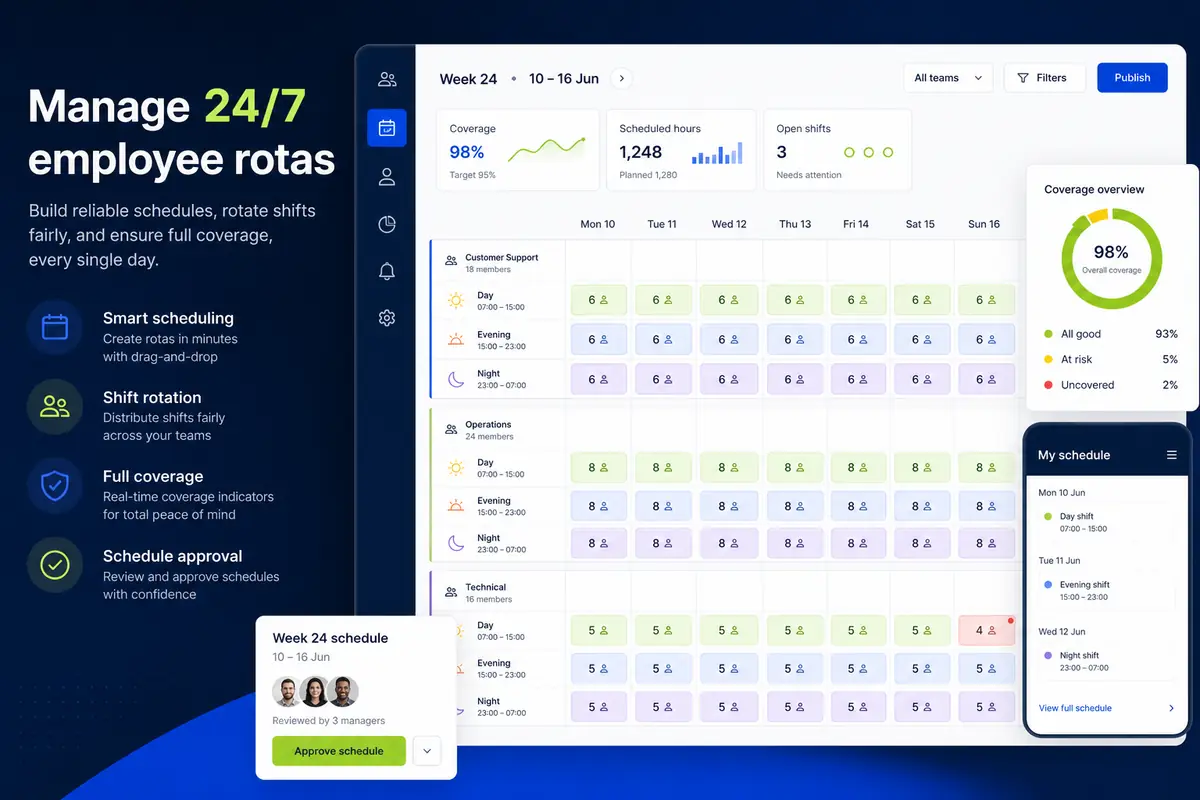
Whatever the pattern, define shift templates with in-time, out-time, a short grace period (fuel outlets cannot tolerate a 15-minute unstaffed nozzle, so grace of 5 to 10 minutes is typical), a half-day threshold and break rules. Rotate attendants across shifts weekly or fortnightly so that the night shift, with its lower footfall but higher risk, is shared. Publish the roster a week ahead and let attendants swap shifts through the app with the manager's approval.
- 16-hour outlets: two 8-hour shifts with peaks double-staffed
- 24-hour outlets: three 8-hour shifts, or 12-hour shifts with overtime paid and days capped
- Short grace period (5 to 10 minutes) because unstaffed nozzles cost sales
- Rotate night duty weekly or fortnightly; publish rosters a week ahead
Tying Cash and Fuel Reconciliation to Shift Attendance
The daily control on a fuel outlet is the reconciliation: for each dispensing unit, closing meter reading minus opening meter reading equals litres sold; litres times price equals expected collection; expected collection must equal cash plus card plus UPI plus credit slips. Any shortage is recovered from, or explained by, the attendant who operated that nozzle in that shift. That is only fair if the attendance record proves who that was.
So make the shift handover a ritual with three simultaneous records: the supervisor's meter reading sheet per dispensing unit, the cash handover from outgoing to incoming cashier, and the attendance check-out and check-in of the two teams. When attendance is captured on a phone or kiosk with a timestamp, the meter reading sheet can reference it, and disputes about who was on nozzle 3 at 21:40 disappear.
Keep the nozzle assignment in the roster, not just in the supervisor's head. A roster line that reads 'Suresh, 14:00 to 22:00, DU-2 nozzles 3 and 4' gives the accountant a clean trail from the sales report to a person to an attendance record. Attend Mitra's shift templates and post assignment let you name the position an employee is assigned to within a shift, and the live monitor shows who is checked in on the forecourt right now, which is exactly the view a manager wants from home at 23:00.
- Reconcile per dispensing unit per shift: meter difference, expected collection, actual collection
- Record meter readings, cash handover and attendance at the same moment at every changeover
- Assign nozzles or dispensing units in the roster so accountability is written before the shift
- Investigate shortages against the attendance record, not memory
Attendance Methods That Survive Dust, Gloves and Shared Phones
Fingerprint devices have a poor record on forecourts. Attendants' fingers are wet with fuel, dusty, sometimes gloved, and the sensor sits outdoors in heat and humidity. Failed reads at shift change create queues and end with the supervisor keying attendance manually, which defeats the purpose. Contactless methods work better.
Face verification on a tablet in kiosk mode at the cabin or sales office is the most practical for outlets: staff walk up, the tablet recognises them with a liveness check, and the record carries the timestamp. It works for staff who do not own a smartphone and avoids a dozen personal-phone installations. Where the outlet has multiple points (forecourt, lube bay, store), a QR code at each point scanned from a phone, with GPS confirming the phone is at the outlet, is a cheap alternative; see how the QR code attendance system prevents remote scanning.
For managers and supervisors who move between outlets, GPS attendance with a geofence around each outlet lets them check in wherever they are. Attend Mitra's kiosk mode runs face verification on a shared Android tablet, supports QR and GPS check-in on personal phones, works offline when the outlet's connectivity drops and syncs later, and gives the dealer a live view across outlets; the petrol pump staff attendance page covers the typical setup.
- Avoid outdoor fingerprint sensors; fuel, dust and gloves cause failed reads
- Kiosk tablet with face verification and liveness at the sales cabin
- QR plus GPS at secondary points for staff with phones
- GPS geofence per outlet for managers covering several sites
- Offline capture with sync for outlets with weak connectivity
Working Hours, Weekly Offs and Overtime
Fuel retail outlets fall under the state Shops and Establishments Act, which sets the daily and weekly hour limits (commonly 9 and 48), the spread-over limit, rest intervals and the weekly off. Most states allow outlets to stay open every day, but each employee must still get a weekly off, which means the roster must rotate offs across the team rather than closing on a fixed day. Read your state's weekly off rules and make sure the roster produces a compliant off for every attendant every week.
Overtime is due at double the ordinary rate for work beyond the daily or weekly limit. Compute the hourly rate as the monthly wage divided by 26 and then by 8, and derive overtime hours from actual check-out times rather than from a fixed assumption. Attendants staying 30 minutes past shift end every day for reconciliation add up to significant overtime over a month; either pay it or fix the handover process. Use the overtime pay calculator to check your figures.
Keep the attendance register, wage register and overtime register in the form your state prescribes; labour inspectors visiting outlets ask for exactly these. Digital records exported to the state format are acceptable in most states, but confirm with your local labour office.
- Rotate weekly offs across the team; outlets open daily but each worker rests weekly
- Hourly rate = monthly wage / 26 / 8; overtime at double for hours beyond the limit
- Derive overtime from actual check-out times, especially post-shift reconciliation time
- Maintain attendance, wage and overtime registers in the state-prescribed form
Salary Structure, Minimum Wage Categories and Incentives
Fuel outlet staff are scheduled employees under state minimum wage notifications, usually with attendants and helpers classified as unskilled or semi-skilled, cashiers and supervisors as semi-skilled or skilled, and managers above the minimum wage grid. The rate depends on the state and often on the zone (metro, municipal, rural) where the outlet sits, and it revises with variable dearness allowance, typically in April and October. Build the current rate by category into your wage master and update it on every notification; the minimum wages compliance guide explains the process.
A typical salary structure is basic plus DA at or above the minimum wage, with an HRA or conveyance component for staff paid above the minimum. Under the Labour Codes, basic plus DA must be at least 50% of total remuneration, so keep allowances proportionate. EPF applies at 12% of basic plus DA up to the ₹25,000 ceiling (effective 17 September 2026), ESIC at 0.75% employee and 3.25% employer on gross up to ₹21,000 for outlets with 10 or more employees in implemented areas. Many outlets cross the 10-employee threshold once night staff are counted, so check your registration status.
Incentives are common: a per-litre or per-shift bonus for lubricant sales, a shortage-free month bonus, or a share of a target-linked payout from the oil company. Because these are tied to shift data (who sold what on which shift), they are far easier to administer when attendance, nozzle assignment and sales are in one record. Keep incentives clearly separate from wages on the payslip so the minimum wage line is visibly met without them.
- Classify roles against your state's minimum wage schedule by skill and zone; update on VDA revisions
- Basic plus DA at least 50% of total remuneration under the Labour Codes
- EPF on basic plus DA up to ₹25,000; ESIC on gross up to ₹21,000 for outlets with 10 or more staff
- Pay incentives from shift-level sales data and show them separately from wages
Attrition, Onboarding and the Monthly Payroll Flow
Attendant turnover is high and seasonal; attendants leave for construction work, return to villages at harvest, or move to a competitor outlet for a small increase. Plan for continuous onboarding: a checklist covering ID and address proof, bank account, EPF UAN and ESIC IP number, uniform issue, safety briefing (fire extinguisher locations, no mobile phones on the forecourt, static discharge, spill procedure) and face enrolment on the kiosk. An attendant should be able to start a shift within a day of joining.
Because staff join and leave mid-month, payroll has to handle partial months cleanly. The 26-day convention gives a per-day wage; multiply by the days actually worked plus proportionate weekly offs. Our guide on salary per day and LOP covers joiners, leavers and absences with examples. Full-and-final settlement for a leaver should include unpaid wages, overtime and any incentive earned, less recoveries for documented shortages under a written policy.
The monthly flow: attendance cutoff on the last day; manager regularises missed punches and approves overtime within two days; payroll run derives LOP and overtime from attendance, applies EPF, ESIC and PT where the state levies it; payslips and bank transfer by the 7th; EPF ECR and ESIC contributions paid by the 15th. Attend Mitra derives LOP and overtime from shift attendance, handles joiners and leavers pro rata, produces payslips and a NEFT file, and exports registers for the labour inspector, though filing the EPF and ESIC returns remains the dealer's or their accountant's job.
- Onboarding checklist: KYC, bank, UAN and IP number, uniform, safety briefing, face enrolment
- Pro-rata wages for joiners and leavers using the 26-day per-day rate
- Written policy for shortage recovery; document every deduction
- Cutoff, regularise, payroll by the 7th, EPF and ESIC by the 15th