
What attendance regularization means
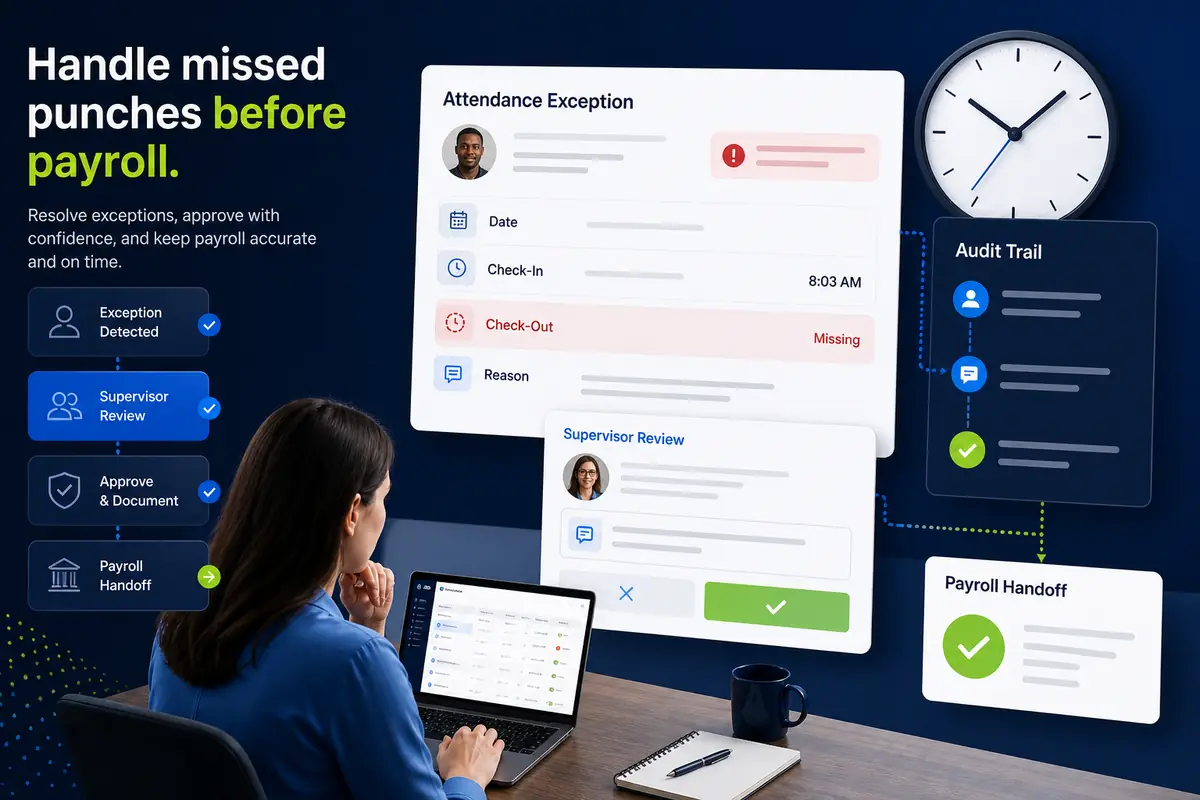
Attendance regularization is the formal process by which an employee asks for a missing or incorrect attendance record to be corrected, a manager or HR approves or rejects the request, and the corrected record replaces the original while the original and the decision remain visible. The word 'regularize' is used because the day is being brought into line with what actually happened. Without such a process, corrections are made informally, by a supervisor editing a register or HR overwriting a cell in Excel, and the register stops being evidence.
The process has three essential parts. A request, raised by the employee with a reason and the intended correction (for example, 'in-punch missed on 12 September, arrived 09:05, please mark present from 09:05'). A decision, by a named approver within a defined time. An audit trail that records who requested, who approved, when, and what changed. Remove any one of these and you have a favour, not a regularization. The attendance regularization glossary entry has the compact definition.
Regularization is distinct from leave. Leave records an approved absence; regularization corrects a record of presence. It is also distinct from a late mark, which is a rule applied to a valid punch that arrived after the grace period. Confusing the three is the root of most attendance disputes, because employees try to regularize lateness away and managers use regularization to grant unofficial leave.
- Request with reason and intended correction, decision by a named approver, audit trail
- Corrects a record of presence; it is not leave and it is not a late-mark waiver
- The original punch and every edit must stay visible after approval
Typical legitimate reasons
Most genuine requests fall into a handful of categories, and your policy should list them so employees pick a reason rather than write an essay. Forgotten punches are the largest group: the employee arrived, worked, and did not mark in or out, often because of a hurried start or a late evening. Device and network failures are next: the biometric machine was down, the app crashed, the phone battery died, the site had no signal and the offline punch did not sync.
Official duty away from the usual location is common for field roles: a client meeting that started before office hours, a bank visit, a training programme at another branch, a supervisor covering a different site. Here the employee was working but the geofence or the device did not see it. Administrative errors also happen: the roster showed the wrong shift so a correct 20:00 punch was read as a 12-hour late arrival, or a new joiner was not yet enrolled on the device.
Each reason has an evidence profile. A forgotten punch is corroborated by the other punch of the day, by system logins or by a colleague's confirmation. A device failure should be visible in the device or app logs and will affect more than one person. Official duty is supported by a calendar entry, a visitor pass or a client acknowledgement. Roster errors are checked against the published roster. The guide on handling missed punches in payroll covers what payroll should do with each.
- Forgot to punch in or out (single missing punch, other punch present)
- Device, app, battery or network failure (usually affects several people the same day)
- Official outdoor duty, client visit, training at another location
- Roster or enrolment error making a correct punch look wrong
- Emergency early exit with verbal permission not recorded
Policy limits: frequency, window and approver chain
Limits are what stop regularization from becoming the default way people mark attendance. Three limits do most of the work. A monthly cap on requests per employee, commonly two or three, beyond which requests still go through but are escalated to HR and treated as a pattern. A submission window after the day in question, typically 3 to 7 calendar days; anything later requires a stronger reason and HR sign-off, and nothing is accepted after the payroll cutoff for that month except through a next-month adjustment. A decision deadline for approvers, usually 2 working days, so requests do not sit unactioned until payroll day.
The approver chain should be short. The reporting manager approves routine requests because he is the person who actually knows whether the employee was at work. HR reviews requests that exceed the monthly cap, fall outside the window, or come from the manager himself. Self-approval must be impossible, and a manager should not be able to regularize a subordinate's attendance without a request from that subordinate, because that is where padding of favoured employees begins.
Set the caps by role and shift reality rather than a single company-wide number. Field staff who legitimately work at client sites several days a week will hit a cap of two quickly if geofence exceptions are routed through regularization; consider a separate pre-approved outdoor-duty mechanism for them. Factory and office staff on a fixed shift with a working device should rarely need more than one a month.
- Monthly cap per employee (2–3 typical); beyond it, HR review and pattern tracking
- Submission window of 3–7 days; hard stop at payroll cutoff, then next-month adjustment
- Approver decision within 2 working days; escalation if unactioned
- Manager approves, HR reviews exceptions; no self-approval, no unrequested edits
Evidence rules and the audit trail
The evidence bar should be proportionate. A single missing out-punch where the in-punch exists and the employee's system activity shows work until evening needs no more than the manager's confirmation. A full missing day with no punches at all needs something external: a client email, a site visitor entry, a training attendance sheet, or a colleague's confirmation recorded in the request. A request that changes an arrival time from 09:45 to 09:00 to avoid a late mark needs proof of the earlier arrival, not a reason for the later one.
The audit trail is not negotiable and it is where most Excel-based processes fail. Every regularization should preserve the original punch data (or its absence), the requested change, the reason code and free-text reason, any attachment, the requester identity and time, the approver identity, decision and time, and the final record as used for payroll. If the record is later edited again, that edit is appended, not overwritten. When a labour inspector, an auditor or a disgruntled former employee asks why a day was marked present, this trail is the answer.
Under the Labour Codes and the older Acts they replace, attendance and wage registers must be maintained and producible. A regularization process with an audit trail is how a digital register meets that requirement; a spreadsheet where cells have been silently changed does not. Keep the trail for as long as you keep the register.
- Match evidence to the change: manager confirmation for one missing punch, external proof for full days
- Preserve original data, request, reason, attachments, approver, decision and timestamps
- Append later edits; never overwrite
- Retain the trail as long as the attendance and wage registers themselves
Abuse patterns and the controls that catch them
Regularization is abused in predictable ways, and each pattern is visible in the data if you look monthly. The serial forgetter raises a request on the same weekday every week, usually to cover a regular late arrival or early departure. The Friday out-punch pattern shows employees leaving early and regularizing the missing out-punch to shift end. The friendly manager approves everything within minutes without reading it, and his team's regularization rate is three times the company average. The pre-cutoff flood is a burst of requests on the last two days before payroll cutoff, many for dates three weeks old.
Controls follow directly. Report regularization rate per employee, per manager and per site every month, and review the outliers rather than the average. Flag requests where the corrected time is exactly the shift start or end; genuine arrivals are 09:04, not 09:00. Require a comment from the approver on any request that removes a late mark or converts a half-day to a full day. Randomly sample approved requests for HR verification, and tell everyone that sampling happens.
The strongest control is design: make it easier to punch correctly than to regularize. Offline capture that syncs later, reminders when a punch is missing at shift end, and a device that actually works remove most of the legitimate reasons and leave the illegitimate ones exposed. A regularization rate that stays high after those fixes is a management problem, not a technology one.
- Monthly outlier report: requests per employee, approval rate per manager, rate per site
- Flag corrections landing exactly on shift start or end times
- Mandatory approver comment when a late mark or half-day is being removed
- Random HR sampling of approved requests, announced in the policy
- Reduce legitimate reasons first: offline sync, missing-punch reminders, working devices
How regularization interacts with LOP and payroll cutoff
A missing punch that is not regularized becomes a decision for payroll, and the policy must say which one. Common practice is to treat a day with a single punch as a half-day and a day with no punch as absent, which flows into loss of pay at the per-day rate; how that rate is derived is explained in how to calculate salary per day and LOP. If the employee regularizes within the window and the manager approves before cutoff, the day is restored and no LOP is deducted. If approval comes after cutoff, the deduction stands in the current month and is reversed as an arrear in the next.
Fix the cutoff and publish it. A typical arrangement is an attendance month running from the 26th to the 25th, a regularization deadline on the 27th, payroll processing from the 28th, and salary credit on the 1st. Employees who know the deadline submit in time; approvers who know the deadline decide in time. Payroll executives should receive a locked attendance file after the regularization deadline, so the numbers they process cannot change under them.
Overtime and late marks follow the same logic. A regularized out-punch that extends the day beyond the shift does not automatically create overtime; overtime requires its own authorisation, and the policy should say so or regularization becomes a back door to overtime pay. A regularized in-punch that moves arrival inside the grace period removes the late mark only if evidence of the earlier arrival exists.
- Define the default for unregularized days: single punch as half-day, no punch as absent, LOP accordingly
- Publish the attendance month, regularization deadline, processing date and credit date
- Lock the attendance file after the deadline; post-cutoff approvals become next-month arrears
- Regularized punches do not create overtime without separate authorisation
Sample request format, sample policy clauses and the in-app workflow
A regularization request should take an employee under a minute to submit and give the approver everything needed to decide in under a minute. On paper or email, the format is: employee name and code; date of attendance; type of correction (missing in-punch, missing out-punch, both, wrong time, wrong site); actual in-time and out-time claimed; reason code from the policy list plus a one-line explanation; supporting evidence attached or referenced; employee signature or submission timestamp; manager decision, comment and date; HR remark if escalated. Everything in the sample clauses below maps to those fields.
In an attendance system the same request lives in the app: the employee opens the day with the missing punch, chooses the correction type and reason, adds a note and photo, and submits. The manager receives a notification, sees the original punch data, the roster for that day, the employee's regularization count for the month and the request, and approves or rejects with a comment. The corrected day flows to payroll only after approval, and the full trail is stored against the record. Attend Mitra implements this workflow with per-employee monthly limits, a configurable submission window, manager and HR approval steps, and an audit trail on every correction, with the corrected record feeding LOP and overtime in the attendance-linked payroll run. The wider set of rules this sits inside is covered in the attendance policy for employees template.
- Clause 1 – Definition: Attendance regularization is the approved correction of a missing or incorrect attendance record. It is not a substitute for leave and does not waive late marks except where evidence of timely arrival is provided.
- Clause 2 – Eligible reasons: Missed punch, device or network failure, official duty at another location, roster or enrolment error, emergency exit with prior verbal permission. Other reasons require HR approval.
- Clause 3 – Submission: Requests must be submitted in the attendance app within [5] calendar days of the attendance date and in all cases before the monthly regularization deadline of the [27th]. Requests after the deadline are processed as next-month adjustments.
- Clause 4 – Limits: An employee may submit up to [3] requests per calendar month. Additional requests are referred to HR and recorded for pattern review.
- Clause 5 – Evidence: A single missing punch requires manager confirmation. A full missing day requires supporting evidence such as a client acknowledgement, visitor entry or training record. Corrections that remove a late mark or convert a half-day require evidence of the claimed time.
- Clause 6 – Approval: The reporting manager decides within [2] working days with a mandatory comment where a late mark or half-day is removed. Requests from managers for their own attendance, and all escalated requests, are decided by HR. No attendance record may be edited without a request from the employee concerned.
- Clause 7 – Payroll effect: Unregularized days with a single punch are treated as half-day and days with no punch as absent, with loss of pay applied at the per-day rate. Approved regularizations before the deadline restore the day; approvals after the deadline are paid as arrears in the following month. Regularized punches do not create overtime without separate authorisation.
- Clause 8 – Audit and review: All requests, decisions and edits are logged and retained with the attendance register. HR reviews monthly regularization rates by employee, manager and site and samples approved requests for verification. Misuse is dealt with under [standing orders/HR manual, clause reference].