
Why guard payroll breaks in Excel
Wage rates differ by state, zone and category
An unarmed guard in Gurugram, an armed guard in Delhi and a supervisor in Noida all sit on different minimum-wage lines; a missed VDA revision underpays hundreds of guards at once.
Duties counted from WhatsApp photos
Payable days are added from site supervisors' messages at month-end, so a guard who covered 30 duties and one who covered 26 are often paid the same.
Overtime paid at single rate or not at all
Guards holding a post for 16 hours because the reliever failed are paid a flat 'double duty' amount instead of overtime at twice the hourly rate.
Deductions on stale ceilings
PF computed on the old ₹15,000 ceiling after 17 September 2026, or ESI stopped mid-period when a guard crosses ₹21,000, creates arrears and notices.
How Attend Mitra runs security agency payroll
State-wise minimum wage master
Maintain wage lines by state, zone and skill category, update them when the VDA notification arrives and link every guard to the correct line.
Payable days from GPS and selfie duty attendance
Each duty is a verified check-in and check-out at the post, so payable days, weekly offs and LOP come from the record, not from a supervisor's memory.
Overtime at twice the hourly rate
Hours beyond the shift or beyond 48 in the week are priced at (monthly wage ÷ 26 ÷ 8) × 2, as the Factories Act and Code on Wages require.
Statutory deductions on current rules
PF on the ₹25,000 ceiling from 17 September 2026 with split handling for September, ESI at 0.75% and 3.25% up to ₹21,000, state professional tax and 8.33% bonus provision.
Payroll features built for security agencies
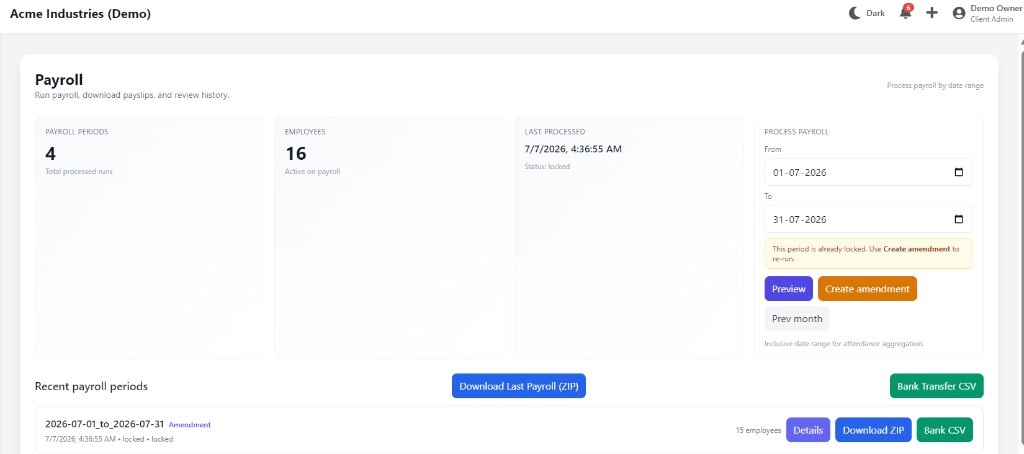
Wage Master by State & Category
Unskilled, semi-skilled, skilled and highly skilled lines per state and zone, with effective dates so April and October revisions apply from the right day.
26-Day Divisor
Per-day wage as monthly wage ÷ 26 for minimum-wage guards; calendar-day or 30-day divisor for supervisors on monthly salary.
Night & Cross-Midnight Duties
A 20:00 to 08:00 post is counted as one duty on the start date, so night guards are not short a day at month-end.
Uniform, Advance & Fine Recoveries
Recurring uniform instalments and one-time salary advances scheduled against future slips with balances visible to the guard.
Payslips in the Guard App
Single or ZIP payslip PDFs showing duties, overtime hours, deductions and net pay, delivered to each guard's phone.
NEFT File & Site-Wise Cost
Bank-transfer file in your bank's format plus a site-wise wage cost export that feeds the client invoice.
Guard payroll: Excel vs WhatsApp attendance vs Attend Mitra
Where each approach stands on the checks a security agency's payroll must pass every month.
| Requirement | Excel salary sheet | WhatsApp attendance + accountant | Attend Mitra |
|---|---|---|---|
| Payable days | Typed from supervisor lists | Counted from group photos | Derived from GPS and selfie duties per post |
| Minimum wage revisions | Manual edit, often late | Accountant informed by phone | Wage lines with effective dates per state and category |
| Overtime rate | Flat double-duty amount | Rarely tracked | Hours × (wage ÷ 26 ÷ 8) × 2, shown on slip |
| PF and ESI ceilings | Formula updated when someone notices | Depends on the accountant | ₹25,000 EPF and ₹21,000 ESI applied automatically |
| Payslip delivery | Printed at branch | Photo of a sheet | PDF in the guard's app, ZIP for records |
| Site-wise cost for billing | Separate workbook | Not available | Exported from the same payroll run |
From Check-In to Payroll-Ready Reports
Wage Master Set
Minimum wage by state, zone and skill category loaded with the current VDA; each guard linked to a category and site.
Duty Attendance Captured
Guards mark in and out at the post with GPS and selfie; night posts crossing midnight count as one duty.
Payable Days Computed
Duties, weekly offs, LOP and extended-post overtime derived from verified records per guard and site.
Deductions Applied
PF, ESI, professional tax, uniform and advance recoveries applied from the settings; bonus provision recorded.
Payslips & NEFT File
Payslip PDFs sent to the guard app, bank-transfer file generated and site-wise cost exported for billing.
What changes on salary day
Salary paid on verified duties
Every payable day traces to a GPS and selfie check-in at the post, which ends the argument between the guard, the supervisor and accounts.
No missed minimum-wage revision
Wage lines with effective dates mean the new VDA applies from the notified date, not from whenever someone remembers to update Excel.
Overtime that survives an inspection
Extended-post hours are recorded and paid at double rate with the calculation shown on the slip, which is what a labour inspector asks to see.
Correct PF and ESI every month
Contributions follow the ₹25,000 EPF ceiling, ESI contribution periods and state PT slabs, so ECR and ESIC challans match the register.
Guards see their own slip
A payslip on the phone with duties listed cuts the queue at the branch office on the 7th of every month.
Cost per site ready for billing
Wage cost, statutory cost and overtime grouped by site flow straight into the client invoice and margin review.
Where security agencies use it
Agency with guards in three states
Posts in Delhi, Haryana and Uttar Pradesh on different minimum-wage schedules, each revised on its own cycle.
e.g. a semi-skilled unarmed guard posted at a Gurugram warehouse is paid on the Haryana line while his colleague at a Delhi showroom is paid on the Delhi line; both slips show the 26-day per-day rate.
Reliever failure creating extended posts
When a reliever does not report, the outgoing guard holds the post and the extra hours must be paid as overtime.
e.g. a guard on the 08:00 to 20:00 post stays until 02:00 because the night reliever was absent; the six extra hours are priced at twice his hourly rate and appear as a separate line on the slip.
Monthly payroll before client payment
The agency must pay guards by the 7th even though the client pays 45 days later, so payroll cannot wait for invoice sign-off.
e.g. attendance is locked on the 1st, payslips and the NEFT file are ready on the 3rd, and the same site-wise cost export becomes the invoice backing on the 5th.
Frequently Asked Questions
Related Pages
Ready to Simplify Guard Payroll Attendance?
Book a free demo and see how Attend Mitra helps Indian businesses track attendance, manage shifts, and export payroll-ready reports.
